
Sub-Total: $0.00
Module 1.0 Final Quiz
Neurodiversity at Work: Strengths, Friction, and Psychosocial Congruence
Understanding neurodiversity matters. Creating work that works for more people is where inclusion becomes practical.
Module 1 has introduced a practical, neuroaffirmative way to think about neurodiversity at work.
Rather than asking neurodivergent people to adapt to rigid systems or treating difference as a problem to be fixed, the module focuses on a different question:
How can we create better conditions for people to contribute, work effectively and sustain their wellbeing?
At the centre of the module is the idea of better fit.
In this context, psychosocial congruence is about the fit between a person and the conditions in which they work. When strengths, tasks, expectations, communication and workplace conditions are better aligned, unnecessary friction may be reduced, and sustainable contribution becomes more achievable.
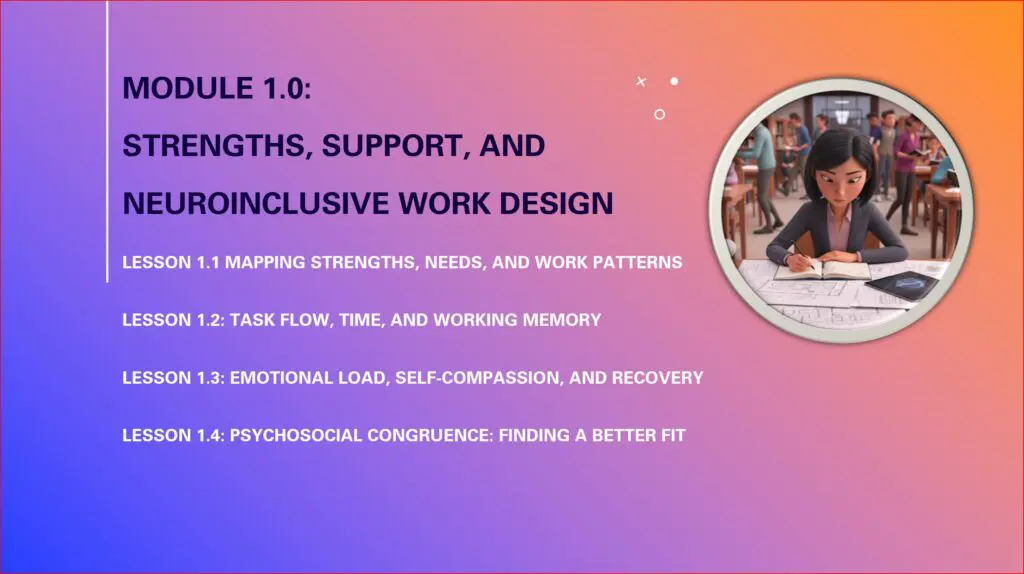
Lesson 1 — Strengths and Work Patterns
You explored how people can bring different strengths, preferences and ways of working to the workplace.
The focus was not on placing people into fixed categories. Instead, you considered how recognising individual strengths and work patterns can help create conditions where people can contribute more effectively.
Lesson 2 — Task Flow and Working Memory
You examined how task design, competing information, unclear priorities and interruptions can increase cognitive load.
You also explored practical ways to make work easier to navigate through greater clarity, structure, sequencing, planning and support.
Lesson 3 — Emotional Load and Recovery
You considered the less-visible effort that work can require, including managing demands, uncertainty, interactions and environmental pressures.
The lesson highlighted the importance of recognising emotional load and creating opportunities for regulation, recovery and sustainable performance.
Lesson 4 — Designing for Better Fit
You brought the module’s ideas together by looking at the relationship between the person, the work, and the surrounding environment.
The goal is not to find one solution that works for everyone. It is to identify sources of unnecessary friction and test realistic changes that may improve clarity, participation, contribution and sustainability.
Your 30-Day Better-Fit Experiment provides a practical way to put this thinking into action through small, observable and adjustable workplace changes.
From learning to practice
Throughout the four microlearning lessons, you have been introduced to mapping activities, planning tools and reflection resources designed to help turn understanding into workplace action.
These approaches can support neurodivergent employees while also creating clearer, more workable environments for colleagues, supervisors, and managers.
That is an important principle of inclusive design: when we reduce unnecessary barriers and create more flexible ways to participate, more people can benefit.
Before you begin the quiz
You are ready to test your understanding if you can:
- recognise the difference between strengths-based and deficit-based approaches to neurodiversity
- identify examples of unnecessary workplace friction
- explain how task design and working memory can interact
- recognise the importance of emotional load and recovery
- identify practical ways to create a better fit between people and their working conditions
Ready?
The Module 1 Final Quiz lets you check your understanding of the key ideas across all four lessons.
The aim is not simply to remember terminology. It is to recognise the concepts, connect them to workplace situations and consider what inclusive practice can look like in action.
When you’re ready, begin the Module 1 Final Quiz.